
About Us
The Need
Mumbai is at a turning point. Over the past few decades, the city has steadily lost its green cover to ever-expanding built-up areas, that have intensified heat and eroded its natural buffers.In some informal settlements, temperatures reach 47°C,while nearby green spaces stay 6–7°C cooler.Heavy rainfall events of >250 mm in a few hours are becoming increasingly frequent – exposing nearly a third of residents to flooding and unsafe public spaces.Recognizing these intertwined challenges, theMumbai Climate Action Plan (MCAP)
calls for expanding green and open spaces, improving biodiversity, and embedding climate resilience into urban design.At its core lies the adoption of nature-based solutions (NbS) – using natural systems to manage heat, flooding, and improve quality of public spaces.
Nature-based solutions offer cost-effective, nature-positive ways to cool the city, absorb runoff, and create more inclusive, resilient neighborhoods – helping Mumbai move toward a greener, more equitable urban future.

The Vision
We envision a Mumbai where – tree canopies shade streets, wetlands absorb floods, and equitable spaces nurture recreation and resilience.
Imagine neighborhoods where summer heat stays near 32°C instead of 45°C; streets that absorb rainwater instead of getting waterlogged every now and then; public parks and riverfronts that welcome children, elders, and communities alike.
A city where every resident regardless of ward or income, enjoys shaded walkways, clean air, and safe spaces close to home. By integrating green and blue systems into daily life, we aim for a resilient, Livable Mumbai, where ecology and community thrive together.
The Approach
We’re co-creating pilot projects with communities, municipal partners, and designers – building capacity so others can adapt and replicate solutions city-wide.
Each pilot is a scalable, context-specific NbS, guided by 5 key questions that identify physical and natural systems under stress, the urban services that need to be integrated, and the social resilience they can strengthen.
This approach creates a shared, actionable understanding of the problems and possibilities at hand. These small, local actions link over time into a blue-green network, helping Mumbai stay resilient, inclusive, and rooted in nature.
Our approach is data-informed and community-grounded, creating interventions that are effective, inclusive, and accessible to all.
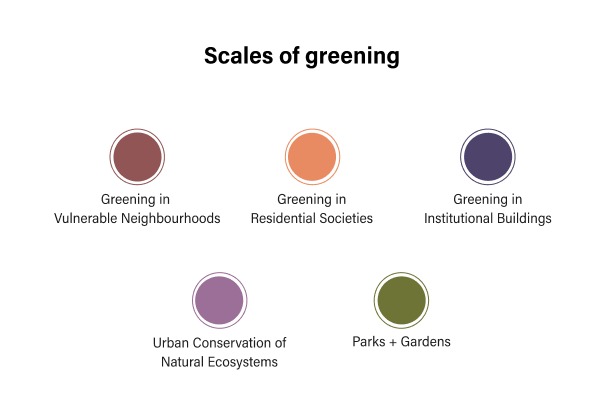
Scales of greening

References:
- Rahaman, S. A., et al. (2021). Monitoring Land Use and Land Cover Change in Mumbai Metropolitan Region Using Remote Sensing and GIS Techniques (1988–2018). Journal of the Indian Society of Remote Sensing, Springer.
- Sanaullah, A., et al. (2021). Urban Expansion and Its Impact on Land Surface Temperature in Mumbai.
- Open City DataJam on Urban Heat (2025). Heat Mapping of Informal Settlements in Mumbai.
- Times of India (2024). BMC Rainfall Analysis: Increasing Frequency of Extreme Rain Events.
- WRI (2023). Flood Risk and Access to Public Space in Mumbai.
- Mumbai Climate Action Plan (MCAP) (2022). Strategies for Urban Climate Resilience.
- Choi, E. (2023). Nature-Based Solutions: Designing with Nature for Urban Resilience.